
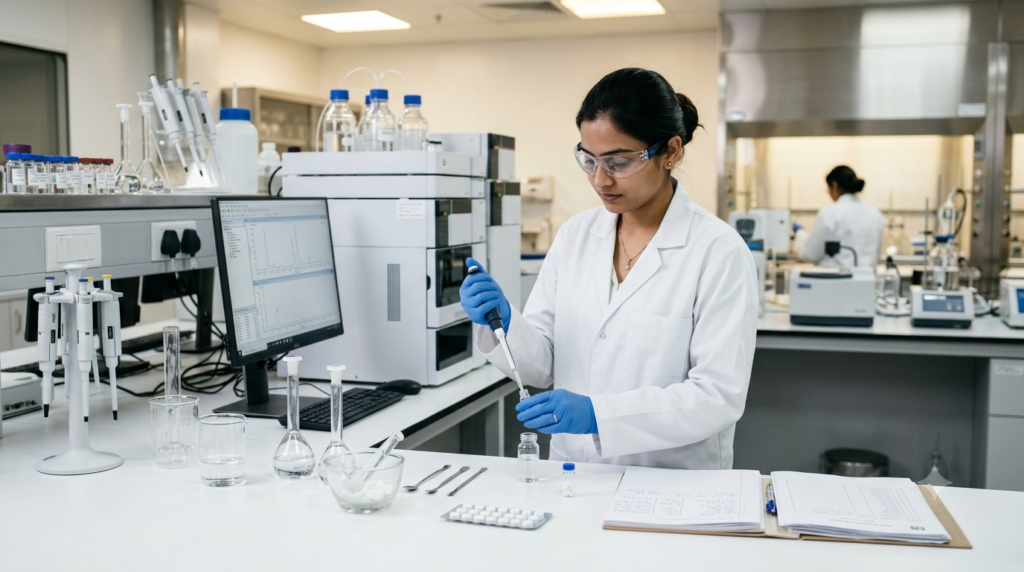
Every pharmaceutical product must meet defined quality requirements before it reaches the market. Quality Control, commonly known as QC, plays an important role in evaluating pharmaceutical materials and finished products.
Quality control involves laboratory testing, sampling, documentation, and evaluation of materials and products against established specifications.
What Is Pharmaceutical Quality Control?
Pharmaceutical Quality Control is a system of laboratory and analytical activities used to assess whether pharmaceutical materials and products meet predefined quality requirements.
QC activities can involve:
- Raw materials
- Packaging materials
- In-process samples
- Finished products
- Stability samples
Testing of Raw Materials
Before production begins, pharmaceutical raw materials may undergo appropriate identification and quality testing.
This helps ensure that materials entering the manufacturing process meet the required specifications.
In-Process Testing
Quality checks can also take place during manufacturing.
Depending on the dosage form and process, manufacturers may monitor characteristics such as:
- Weight
- Appearance
- Uniformity
- Moisture
- Physical properties
- Process parameters
These checks help identify potential problems before a batch reaches the final stage.
Finished Product Testing
Finished pharmaceutical products may undergo several tests depending on their formulation and applicable specifications.
Examples include:
Assay
Assay testing can determine the amount of active ingredient present in a product.
Dissolution
Dissolution testing evaluates how a drug substance is released from a dosage form under specified test conditions.
Identification
Identification testing helps confirm the identity of the relevant ingredient or material.
Microbiological Testing
Certain pharmaceutical products require microbiological examination to evaluate relevant microbial quality characteristics.
Stability Testing
Stability studies help evaluate how a pharmaceutical product behaves under defined storage conditions over time.
Information generated from stability studies can support appropriate storage conditions and shelf-life decisions.
Why Quality Control Matters
Quality cannot be created by testing alone. Quality needs to be built into pharmaceutical manufacturing through controlled processes, suitable facilities, trained personnel, and effective quality systems.
WHO describes GMP as a system that ensures products are consistently produced and controlled according to appropriate quality standards.
Quality Control and Quality Assurance
Quality Control focuses heavily on testing and evaluation, while Quality Assurance provides the broader system for ensuring that appropriate processes and controls are established.
Together, these functions support pharmaceutical quality throughout the product lifecycle.
Conclusion
Pharmaceutical Quality Control is an essential component of medicine manufacturing. From raw materials to finished products, appropriate testing and documented procedures help manufacturers verify that products meet established specifications.
Strong quality systems help pharmaceutical manufacturers maintain consistency, traceability, and confidence throughout production.