
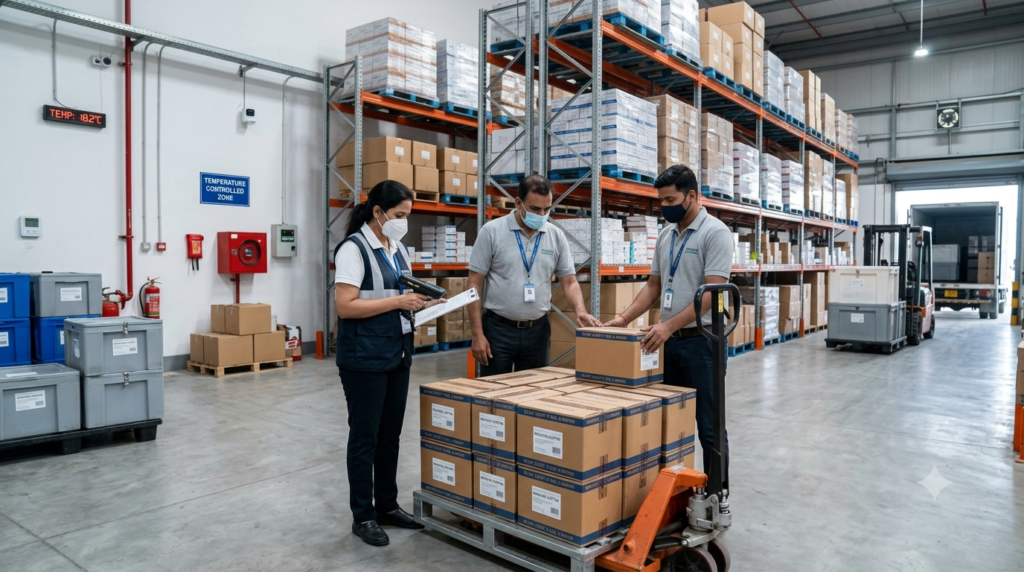
Manufacturing a pharmaceutical product is only one part of the journey. After production and quality release, medicines must be stored, handled, and distributed through appropriate supply-chain systems.
A well-managed pharmaceutical supply chain helps preserve product quality from the manufacturing facility to healthcare providers.
Step 1: Manufacturing
The journey begins with controlled pharmaceutical manufacturing.
Depending on the dosage form, production may involve processes such as blending, granulation, compression, filling, coating, filtration, or other specialized operations.
Step 2: Quality Evaluation
Before distribution, appropriate quality checks and release procedures are completed.
Products must meet applicable specifications and quality requirements before they proceed through the supply chain.
Step 3: Packaging
After manufacturing and relevant quality activities, products are packaged in suitable primary and secondary packaging systems.
Packaging helps protect the product and provides important identification and traceability information.
Step 4: Storage
Pharmaceutical products must be stored under conditions appropriate for the product.
Depending on the medicine, storage requirements can include controls for:
- Temperature
- Humidity
- Light
- Cleanliness
- Handling
Step 5: Distribution
Products are transported through pharmaceutical distribution networks to reach appropriate customers and healthcare channels.
Distribution systems need appropriate documentation and controls to maintain product integrity.
Why Traceability Matters
Traceability allows pharmaceutical products to be identified and tracked through relevant stages of the supply chain.
Batch information and documentation can support inventory management, quality investigations, and product recall processes when required.
Maintaining Product Integrity
The pharmaceutical supply chain must be managed carefully because inappropriate storage or transportation conditions can affect certain products.
WHO guidance recognizes storage and distribution as important components of pharmaceutical quality systems.
The Importance of an Integrated Supply Chain
Manufacturing, quality control, packaging, storage, and distribution should work as connected parts of the pharmaceutical lifecycle.
Strong coordination between these stages helps support consistent product quality and reliable availability.
Conclusion
The journey of a pharmaceutical product does not end when manufacturing is complete. Proper packaging, storage, documentation, transportation, and distribution are essential parts of delivering medicines through the healthcare supply chain.
A well-controlled pharmaceutical supply chain helps maintain product integrity from the manufacturing facility to the point of use.