
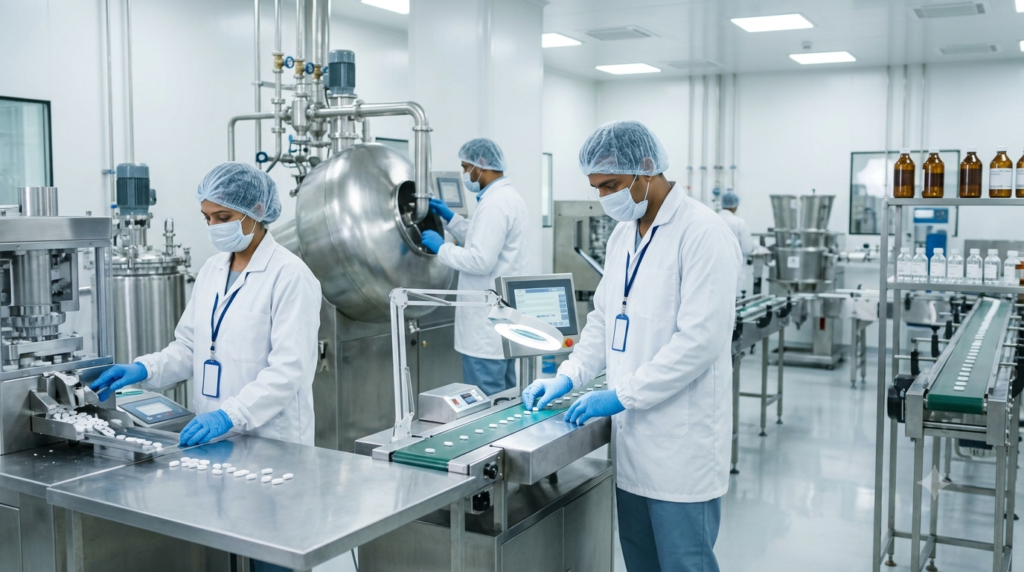
Understanding Good Manufacturing Practices (GMP) in the Pharmaceutical Industry
The quality of a medicine depends on much more than the ingredients used to make it. Pharmaceutical products must be manufactured under controlled conditions to ensure consistent quality, safety, purity, and performance. This is where Good Manufacturing Practices, commonly known as GMP, play an important role.
GMP provides a structured framework for controlling pharmaceutical manufacturing processes and reducing risks such as contamination, mix-ups, incorrect labeling, and inconsistent product quality.
What Is GMP?
Good Manufacturing Practices are quality systems and procedures designed to ensure that medicines are consistently produced and controlled according to appropriate quality standards.
GMP covers multiple aspects of pharmaceutical production, including:
- Raw materials and suppliers
- Manufacturing processes
- Production facilities
- Equipment and maintenance
- Personnel training
- Documentation
- Quality control
- Packaging and labeling
- Storage and distribution
The goal is to build quality into the manufacturing process rather than relying only on testing the finished product.
Why Is GMP Important?
Pharmaceutical products directly affect patient health, making manufacturing quality extremely important.
A strong GMP system helps manufacturers reduce the risk of:
- Contamination
- Product mix-ups
- Incorrect quantities of active ingredients
- Manufacturing errors
- Incorrect labeling
- Cross-contamination
According to the World Health Organization, GMP is intended to ensure that pharmaceutical products are consistently produced and controlled according to appropriate quality standards.
Key Elements of GMP
1. Quality Management
A pharmaceutical manufacturer needs a structured quality management system covering production, testing, documentation, investigations, and corrective actions.
2. Qualified Personnel
Employees involved in manufacturing and quality activities must receive appropriate training and understand the procedures relevant to their responsibilities.
3. Suitable Facilities and Equipment
Manufacturing areas and equipment should be appropriately designed, maintained, cleaned, and controlled to minimize contamination and manufacturing risks.
4. Controlled Manufacturing Processes
Manufacturing processes should follow approved procedures and appropriate controls to ensure consistency between batches.
5. Documentation
Accurate documentation provides evidence that manufacturing activities have been performed correctly and allows products and processes to be traced.
GMP and Quality Control
Quality control laboratories perform testing on materials and products, but testing alone cannot create quality.
Quality needs to be controlled throughout the manufacturing process. FDA explains that CGMP requirements include controls over manufacturing operations, raw materials, procedures, facilities, equipment, and testing laboratories.
GMP and Patient Safety
The ultimate purpose of pharmaceutical quality systems is to help ensure that patients receive medicines that meet established quality requirements.
From receiving raw materials to manufacturing, packaging, storage, and distribution, each stage contributes to the final quality of the product.
Conclusion
GMP is a fundamental part of modern pharmaceutical manufacturing. It creates a systematic approach to controlling materials, processes, equipment, people, documentation, and quality systems.
For pharmaceutical manufacturers, following GMP principles is not simply about meeting regulatory expectations—it is about maintaining consistent quality and supporting patient safety at every stage of production.
Advanced Health Network focuses on pharmaceutical manufacturing and quality-driven healthcare solutions designed to support reliable pharmaceutical products and industry requirements.